
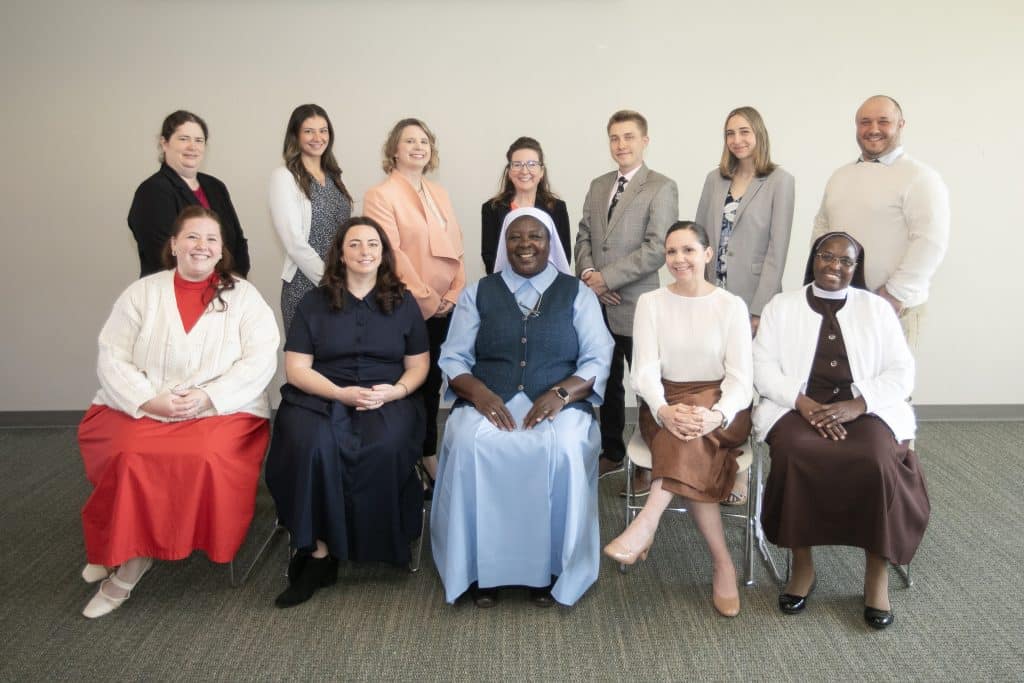
ASEC Staff in USA
The mission of African Sisters Education Collaborative, or ASEC (AYE-sek), is to educate Catholic women religious in Africa to strengthen their leadership capacity to provide services that address local and global challenges.
Our vision is to be a sustainable organization with a proven capacity to collaborate, develop, and deliver educational programs that strengthen the capacity of women religious in Africa.
Core Values

Transformation
ASEC provides educational opportunities for women religious in Africa in order to facilitate attainment of their human potential, as well as that of the people in the communities and societies they serve, with special concern for persons most in need.

Collaboration
ASEC nurtures multi-layered partnerships that further its mission in accordance with the gospel call to unity and solidarity. Recognizing the shared goal of furthering educational opportunities for women religious in Africa, ASEC works together with partners in the spirit of global sisterhood to support the personal and spiritual growth of sisters in Africa.

Leadership
ASEC fosters the leadership capacity of women religious in Africa to leverage their strengths and those of their sisters, staff, students, and others they influence, to achieve common goals while developing their individual gifts and talents.

Service
ASEC cultivates an environment of service among its stakeholders by promoting social responsibility and community engagement to meet the needs of society. ASEC recognizes that women religious in Africa devote their lives to service in a spirit of compassion, humility, love, and protection for all of God’s creation.

Capacity- Building
ASEC is committed to strengthening skills, competencies, and credentials of women religious in Africa, by transferring capacity of experts through training to increase their ability to build sustainable programs and organizations that address the social, human, and spiritual needs of their societies.

Reverence
ASEC respects the special value, unique talents and gifts of each person created and sustained by God. To revere life, is to act and respond with deep respect and compassion for the dignity and diversity inherent in humanity. ASEC extends services across multiple cultures and communities, to the global north and south, operating with an appreciation for the uniqueness of people and their worldviews; and with empathy by listening, reflecting, and promoting communication that is meaningful, honest, and inclusive.
Catholic sisters dedicate their lives to serving the poor and vulnerable. They work tirelessly to improve the lives of the people and communities they serve. Yet many African Sisters lack the education and professional credentials needed to fully support the essential ministries they lead. In fact, of the over 40,000 Sisters in the 11 countries ASEC serves, 48% have no higher education credentials.
We are changing that statistic.

The African Sisters Education Collaborative (ASEC) was established in 1999 by four Catholic universities in the U.S.:
- Chestnut Hill College
- Marywood University
- Neumann University
- Rosemont College
- the Sisters of Saint Joseph of Philadelphia
- the Sisters, Servants of the Immaculate Heart of Mary of Scranton
- the Sisters of Saint Francis of Philadelphia
- the Society of the Holy Child Jesus
We received 501(c)(3) nonprofit approval in 2006, with a goal to increase African sisters’ access to education and professional training. That same year, ASEC set up computer labs and began providing technology workshops to African sisters in five pilot countries: Ghana, Nigeria, Kenya, Uganda, and Tanzania. ASEC now serves 11 countries in Africa.

ASEC Staff in Africa
Education equips sisters to create lasting change.
When Catholic sisters gain the knowledge and skills they need to lead, entire communities benefit. ASEC alumni use their education to strengthen healthcare, education, economic opportunity, and other essential services that improve lives across Africa.
To date, ASEC has served over 10,900 Sisters through its programs, and that number continues to grow.