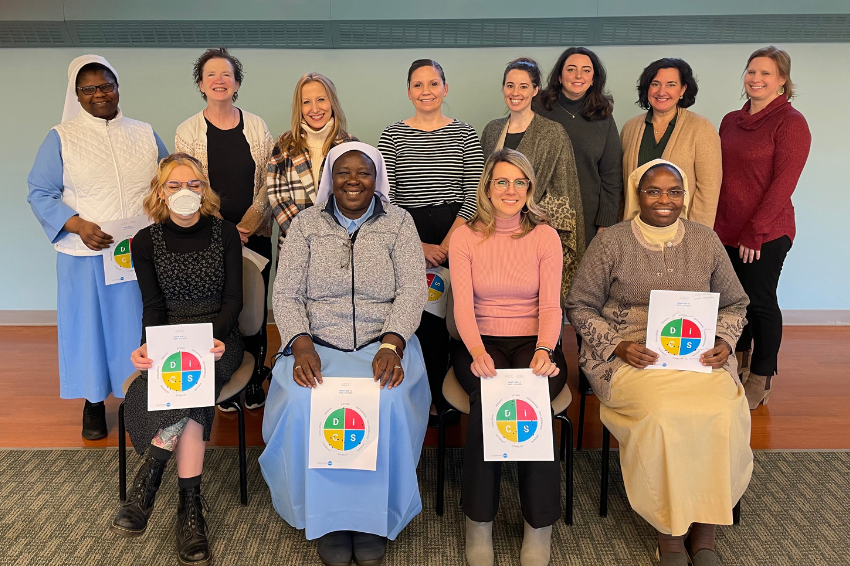
The Collective 180, a consulting group that helps foster positive workplace relationships and environments through assessment-based training and development, spent two days with US ASEC staff recently. This is what we learned.
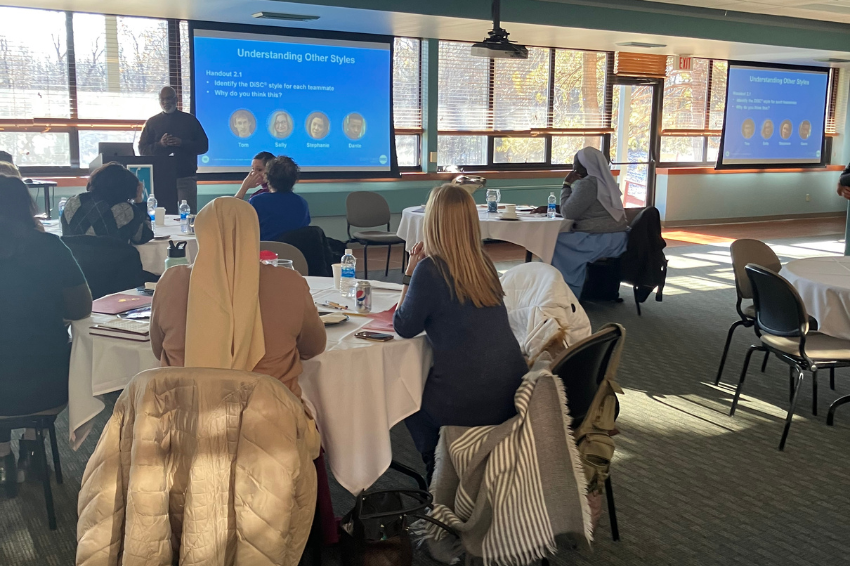
On Wednesday, February 1, and Thursday, February 2, 2023, ASEC US staff participated in a development training to foster success in workplace relationships. The training was hosted by The Collective 180, a consulting agency that facilitates productive and healthy workplace relationships by assessing work styles and providing suggestions for development. Their website reads, “The Collective 180 is a team of professionals and friends dedicated to creating safe spaces at work so individuals can be their full selves, uncover their dreams, and achieve their goals.”
In order to discover each team member’s productivity or work style, each member took the DiSC assessment. According to DiscProfile.com, the DiSC assessment is “a personal assessment tool used by more than one million people every year to help improve teamwork, communication, and productivity in the workplace.” By breaking down teams into recognizable work styles, team members are then able to better understand each other and create an inclusive team language to incorporate all styles. That is the goal, anyway.
DiSC is separated into four quadrants, each having a corresponding letter, color and three attributes. Together the four categories create a full circle, which signifies the entire work culture.
The “D” category, which is green, holds the attributes challenge, result and action, and is in the upper left-hand quadrant of the circle. The “D” stands for dominant, and an employee whose assessment lands them in the “D” category is oftentimes results-driven and sure of their ideas, but may come across as hasty to other members who are more analytical or detail-oriented.
Read Rays of Hope
Learn more about Catholic Sisters transforming poor, rural communities across Africa in our FREE Rays of Hope ebook.
The upper right side quadrant is “i”, which stands for influence and is colored in red, has the attributes of action, enthusiasm and cooperation. Team members who score high in this category tend to have high morale and value people and relationships. They may have diplomacy skills that allow them to persuade others, but at the same time, they may experience more delays in productivity by focusing on relationships rather than results.
In the lower right quadrant, colored blue, is the letter “S” for steadiness. The three attributes found in this category are cooperation, support and stability. Team members with this work style place emphasis on supporting each other and a steady work environment. If the environment becomes unpredictable or there are a lot of risks on the table, people with this work style may become anxious or stressed.
The last style, included in the lower left quadrant and colored yellow, is the “C” category, which stands for conscientiousness. The attributes held in this category are stability, accuracy and challenge. Members of the team with this style tend to pay close attention to detail and will take strong measures to ensure accuracy. A potential stressful situation for this type of employee would be a quick deadline that doesn’t allow for planning or re-checking completed work.
It is important to note that an employee’s work style doesn’t need to be confined to one category. Many times employees will be in between two quadrants and have a blend of attributes from both. There is also the possibility of an employee who has a specialized skill outside of their quadrant, which they may have taken the time to develop on their own or in other circumstances.
During the development training, team members received a detailed report of their work style, which included information about workplace situations in which they would thrive and those that might present a challenge. Being able to share these assessments with fellow co-workers and learn about each other’s styles helped us understand how we can work more successfully together in the future and be mindful of our differences. It might not seem to be a big deal to someone assertive to assert their opinions, but other work types might struggle to understand the intensity and quickness. Just the same, one coworker may need to remind others of a deadline if they seem to get stuck on double-checking the details.
The DiSC assessment can also help to pinpoint the strengths and weaknesses within the organization as a whole. Each employee was represented in their quadrant with a black dot, and when all the team members were shown it gave us a clear picture of the places we thrive and places where we may need to work harder to get results. Having this awareness allows us to make valuable changes to increase productivity as well as to understand ourselves and our own workplace needs better.
The assessment can be found and taken online through a quick Google search, although I have not found a free version yet.
ASEC gives a warm thank you to Patrick Soloman and Joe Iarocci from the 180 Collective, who facilitated the training and helped us understand ourselves and one another better. No doubt at least some workplace tangles will be untangled as a result. We had a great time!
Be a Ray of Hope
Communities across Africa are counting on Catholic Sisters, but 48 lack the education needed to carry out their important mission work. You can be a Ray of Hope for a Sister who needs you by donating to her education today.
This article is addressing the following UN Sustainable Development Goal(s):